

We’ve received over 200 questions about the overhaul of Disability Access Service (DAS) at Walt Disney World and Disneyland. This FAQ answers common inquiries about eligibility changes, mechanics of how DAS works (and doesn’t), reasons for new policies, how they should cut down on Lightning Lane misuse, and much more.
This comes as a follow-up to the news that Disney has once again redone DAS at Walt Disney World and Disneyland due in large part to abuse and proliferation of the program’s use. That article covers a lot of ground about the specifics of the new-look Disability Access Service, plus our commentary about winners & losers, as well as collateral damage and more.
In the year-plus since the new-look DAS launched, we’ve received a ton of reader questions and Disney has likewise made multiple changes to the service. The motivation for some of these tweaks might’ve been the Disability Access Service Class Action Lawsuit Filed Against Disney Parks. It seems like some changes might’ve been made in response to that complaint and a demand letter that preceded the lawsuit. It’s possible the outcome of that litigation will result in future changes, but we wouldn’t count on it.
This FAQ combines public information that Walt Disney World has released, questions we’ve been able to get answered during discussions with Disney’s team working on the DAS overhaul, informed speculation based on reading between the lines of the policies, practical realities of ADA compliance, and more.
This is still going to be a long one, so let’s dig right into the FAQ…
How do you register for DAS?
Registration is available via live video chat.
The Guest for whom DAS is being requested must be present during the video chat. The recording of this video chat is strictly prohibited. (These are both new rules as of late 2025.)
When can guests register for DAS?
As of 2025, both Walt Disney World and Disneyland Resort have extended the DAS registration window to 60 days prior to their park visit. Previously, the process could begin no sooner than 30 days prior to your visit.
With the extension of DAS applications to 60 days, guests should be able to make an informed decision about their status and cancel if they’re denied and feel visiting Walt Disney World will not be feasible or desirable without the DAS accommodation. Guests who booked vacation packages who apply for DAS sufficiently early will be able to receive full refunds as a matter of policy.

Is in-person same-day registration available at Walt Disney World?
No and yes. Same day registration is still available by visiting Guest Relations, but it will not be in-person in the sense that you’ll be speaking face-to-face with a Cast Member inside the park. You’ll be directed to a location and given a device to conduct the live video chat. It’ll work exactly like it would from outside the park, except you’ll be wasting precious vacation time to do so.
Given that alone–and the possibility of this taking extra time based on demand–we highly recommend going the pre-arrival route at Walt Disney World. Nothing is going to change, outcome-wise, with getting or not getting DAS. It’s just where you take the time to go through the process.
What’s the maximum DAS party size?
DAS registration maximum party size is the registered DAS guest and all members of their immediate family (parents and siblings), but otherwise up to 3 additional party members, for a total of 4 people.
This means that if the DAS guest brings both of their parents, three sisters, and two brothers (total party size of 8)–that’s fine. But if a DAS guest brings both parents and one sibling (total party size of 4), they would NOT also be able to bring their two grandparents who footed the bill for the trip.
Once outside the nuclear family, the party size cap is 4 people, and that includes the DAS guest. (This is not speculative–I confirmed with Disney since it was a question we were getting a lot.)
How long is DAS valid?
In 2025, both Walt Disney World and Disneyland extended the validity period for Disability Access Service upon a guest being accepted into the program to one year or the length of the ticket (whichever is shorter). Prior to this up to 365 day window, DAS was valid for up to 240 days before re-registration.
The big beneficiary of that change was Annual Passholders, and meant that they would not have to re-register for DAS two-thirds of the way through their AP validity window. That made DAS more convenient for locals and other regulars, while also adding a layer of predictability, and it came right as the first wave of DAS Annual Passholders would’ve been up for renewal.
For which disabilities is DAS intended?
According to Walt Disney World, “DAS is intended to accommodate those Guests who, due to a developmental disability like autism or similar, are unable to wait in a conventional queue for an extended period of time.”
This line (or a variation thereof) can be found repeatedly throughout Walt Disney World’s new DAS resources. From that, it is clear that they’re trying to recalibrate expectations about the intended recipients of DAS.
On its DAS page, the company also warns that “waiting in line is a regular part of the Walt Disney World Resort experience.” It goes on to advise that guests prepare to visit by practicing waiting at home or in lines at places they might already frequent.

Does that mean that DAS has been narrowed in scope to only guests with developmental disabilities?
Not entirely. During the video chat, Inspire Health Alliance’s health professionals will work with Disney Cast Members to determine eligibility for appropriate accommodations and ensure that these accommodations are provided only for the guests for whom they are intended.
This will mean having a personalized conversation about each guest’s unique needs and the services they might require to determine whether DAS is appropriate or whether the guest should be directed to other types of services available, including but not limited to a line-return option for guests who may need to visit the restroom with greater frequency, ASL interpreting services, and wheelchair or other mobility device access.
This may sound vague and unclear, and that’s partly by (Disney’s) design. Just keep in mind that the ADA requires businesses that are open to the public to make reasonable modifications to policies, practices, and procedures where needed. If your individual circumstances are such that a different accommodation is not suitable and only DAS will work for you, for whatever reason, it is likely to be the accommodation you’re granted, developmental disability or not.
The basis of my conclusion is not necessarily anything Walt Disney World has said, although there are several wiggle words (personalized conversations, each guests unique needs, etc.) that suggest requests will be evaluated on a case-by-case basis. Moreover, there’s the matter of federal law, which Disney obviously has the good sense (and legal team!) to know not to violate.

So DAS won’t be issued to fewer guests with actual disabilities?
This is where things get tricky. It is a near-certainty that fewer actually disabled guests will be deemed eligible for DAS. While Disney won’t outright say as much, that is clearly one goal of these changes. This is something we’ve covered separately since the rollout of the overhaul in Changes & DAS Denials at Disney.
However, this has less to do with a changing of who qualifies for accommodations and more to do with the process for evaluating DAS requests. In the past, it was not very rigorous and was more or less a rubber stamping once certain words were said.
This also was by design, especially in-park where Guest Relations Cast Members were given the unenviable task of evaluating DAS requests. It was better for them to err on the side of asking too little and issuing DAS too often, both as a matter of law and the Four Keys.
As a result, DAS was issued to legitimately disabled guests in many scenarios where other accommodations were available. These guests were not abusers (we dubbed them “unwitting misusers” in our previous post about DAS) as their requests were genuine, and they were simply following established procedure. If reevaluated once the new policies take effect, many of them would not receive DAS. So in short, the outcome is reducing the frequency with which DAS is issued.

Will these changes totally eliminate abuse?
Definitely not. There’s no perfect DAS system, and reform cannot be narrowly tailored in such a way that it only hurts the abusers. That just isn’t realistic. The sad reality is that some scammers are incredibly clever and will always find a way to exploit a loophole and outfox a system. The more Disney clamps down to try to stop them, the more disabled guests become unintended casualties, and the more likely it is that the system runs afoul of the ADA.
There’s no flawless means of eliminating abuse. The best I can think of is actually stigmatizing the losers who abuse DAS so they’re not as loud and proud of their awful actions. But in a world where reality television and social media fame seemingly reward the worst of society, that too seems unrealistic.
Why isn’t Disney using IBCCES?
Walt Disney World is not using the International Board of Credentialing and Continuing Education Standards (IBCCES) that has become somewhat of an industry standard. Many other parks have switched to this, including Universal Orlando.
With IBCCES, guests must sign up before their visit and upload documentation for review. Upon qualifying via IBCCES for the Individual Accessibility Card (IAC) prior to their visit, the theme park operators then contact them about accommodations they may need. From there, Universal Team Members may approve them for the Attractions Assistance Pass.
This is a more rigorous system that decreases the likelihood of abuse while also minimizing the number of legitimately disabled guests who are erroneously denied accommodations. In our view, this is the better approach on balance if the goal is to weed out the abusers while still granting the Attractions Assistance Pass to disabled guests. There’s less collateral damage, so to speak, with this approach.
IBCCES is also more controversial. There has already been litigation in California involving IBCCES, with one lawsuit focusing on the pre-planning requirement at Six Flags Magic Mountain. There are also concerns about the use of an intermediary with regard to medical privacy and more. I would not be the least bit surprised if there’s more litigation involving IBCCES. I won’t pretend to know how that will all be decided.
Not wanting to be on the losing side of ADA cases, my strong suspicion is that Disney Legal performed litigation risk assessments on IBCCES and steered DAS in a different direction as a result. I also wouldn’t be the least bit surprised if the next DAS overhaul does involve IBCCES, should they prevail in pending and future litigation. All of this is purely speculative on my part.
In an update, Universal is no longer requiring the controversial IBCCES to qualify for the Attractions Assistance Pass. This is undoubtedly due to the Six Flags litigation, and the company’s concern about potential legal exposure. Guests still may use IBCCES to streamline the process, but it’s not mandatory at Universal.

Why isn’t Disney requiring medical paperwork?
Many disabled guests have welcomed Walt Disney World requiring medical paperwork or proof of a disability as a means of reducing abuse. Some say this is hardly burdensome, as they need this for many aspects of their day-to-day lives. A few indicated they have even brought this to Guest Relations in the past, and Cast Members actually refused to look at it.
This is also all by design. Just as Walt Disney World doesn’t want to run afoul of the ADA, they don’t want to violate the Health Insurance Portability and Accountability Act (HIPAA, not HIPPA). Based on my admittedly limited understanding of public health and administrative law, I think concerns about HIPAA and its limiting factor are probably overblown. It’s not a blanket prohibition on disclosures (especially voluntary ones) or requests to provide documentation for substantiation or to provide the bases for a request for accommodations.
Nevertheless, much like public perceptions (and misconceptions) of the First Amendment, HIPAA acts as a powerful incentive for businesses to treat medical information with care and act in the spirit of that act to comport with public perceptions and expectations.
It’s also important to remember that Disney policies have to be implemented by Cast Members, presenting the opportunity for human error or oversight. On top of that, Disney is conservative and risk-averse with its policies, which is probably fair–the company has a bullseye on its back when it comes to litigation.

How does Attraction Queue Re-Entry work for guests who need to exit the standby line and re-enter?
Guests with specific needs that may arise while waiting in an attraction queue may exit the queue while the rest of their party waits in the queue. The guest may then re-enter the queue prior to boarding the ride. A guest may also wait outside the queue and meet up with their party before boarding the ride if needed based on the nature or condition of the queue at a particular attraction and the Guest’s specific needs. Every attraction has a defined process to support these options.
At the entrance of the attraction, talk with a Cast Member to learn about exit options should you need to leave the queue. In the event your specific need requires you to leave the queue, simply exit while the remainder of your party stays in the queue.
When you are ready to return, go to the front of the attraction and let a Cast Member know that you are using the Attraction Queue Re-Entry accommodation and need to regroup with your party in the queue, and they will help you meet your group to ride together. You do not need to discuss your reason for needing to leave the queue with Cast Members or other guests.
How will video calls work for international visitors?
International visitors have reported having issues connecting with the video chats necessary to complete the pre-arrival DAS process. There are workarounds for this (VPN, etc.) that could and should still work, although that’s not Walt Disney World’s official advice.
Disney’s recommendation is to complete the process via video chat upon arriving in the United States but before coming to the parks. Failing that, there will be an in-park option as discussed above (iPads at Guest Relations). So really, you want to figure out a way to do this before getting to Walt Disney World and there’s no guarantee that the video chat will work abroad without employing a workaround.

Is DAS issued at Walt Disney World valid at Disneyland, or vice-versa?
DAS is valid only on the coast where it was issued. DAS issued at Walt Disney World is not valid at the Disneyland Resort, and vice versa.
What happens if statements made by guests during the DAS registration process are found to be false?
If it is determined that any of the statements a Guest made in the process of obtaining DAS are not true, the Guest will be permanently barred from entering Walt Disney World Resort and the Disneyland Resort, and any previously purchased Annual Passes, Magic Key passes, tickets and other park products and services will be forfeited and not refunded.
Note that this is not a new policy, and has been in place since (at least) the changes introduced alongside Lightning Lanes. It’s probably unenforceable (absent a guest outright stating that they lied to a Cast Member), but I nevertheless wish that Disney were publicizing this more.
Where do guests receive DAS return times?
Guests utilizing DAS (and their party members) can make return time selections right from the My Disney Experience app during the day of their park visit. Registered guests using DAS and members of their party will be able to book, redeem, change or cancel DAS return times using the My Disney Experience app via a smart phone or other smart device.
If additional assistance is required, guests can also obtain return times directly from a Cast Member at any Guest Relations or Guest Experience Team location (the blue umbrella stands, pictured above).
Can guests still pre-register for ride return times prior to their visit?
No. Only after you’ve registered and entered the theme park, can you request your first return time.
What can guests do during their virtual wait?
Guests utilizing DAS can enjoy many other experiences throughout Walt Disney World Resort during a DAS virtual wait, such as other rides, shows, entertainment, parades and character meet & greets. They can also take a rest in a break area, get something to eat or go shopping.

Does the Guest utilizing DAS have to be present to obtain a return time at a Guest Relations or Guest Experience Team location?
No. Any member of the DAS-eligible guest’s travel party may obtain a return time, but the guest registered for DAS must be present and experience the attraction with their party.
Does a Guest utilizing DAS have to ride the attraction at the exact return time listed?
No. DAS return times are not limited to a specific window and are valid until the park closes or an attraction closes for the day.
Can a Guest have more than one active DAS return time at one time?
No. A guest may only have one DAS return time at a time. Guests may obtain another return time for the same or a different attraction 10 minutes after they redeem their previous DAS selection.

Are these changes being made to sell more Lightning Lanes?
One goal is undoubtedly to push DAS abusers into purchasing Lightning Lanes, rather than scamming a way of getting them for free. Similar to how Disney+ has started a crackdown on password sharing. (I’d argue they’re not equivalent offenses on an ethical level, but both are breaking rules.)
However, the assumption that this will free up inventory to sell more Lightning Lanes is mostly wrong. Lightning Lane Multi-Pass selling out is fairly rare, so the ‘more inventory’ angle for selling more Lightning Lanes only applies to those dates.
For most days, the limiting factor on Lightning Lanes is demand–not supply. Lightning Lane Single Pass are a somewhat different story in that they’re more frequently supply-constrained, so this could have a bigger impact on sales of those.
Moreover, Lightning Lane utilization, both paid and via Disability Access Service, has decreased year over year. We’ve written a lot about the impact of the DAS changes on wait times at Walt Disney World. Most recently in Is Lightning Lane Multi Pass Still “Worth It” at Disney World?
So why did these changes actually happen?
The short answer is misuse and abuse.
Walt Disney World has publicly stated that DAS usage has tripled since 2019. Independent of that and prior to it, we received credible reports that the majority of Lightning Lane usage is actually DAS. Just to put that into perspective for people who might be inclined to believe that DAS is still a low number in the grand scheme of things or relative to Lightning Lanes as a whole. It’s not.
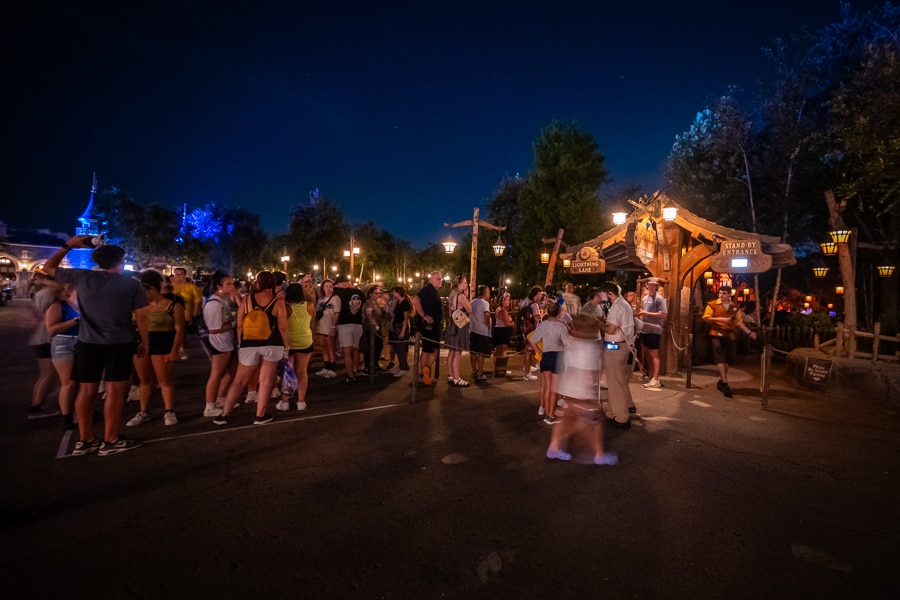
Does DAS give guests an advantage?
Yes. There’s been a lot of debate about this, but the answer is yes, statistically speaking.
This has come out during past litigation about the system, during which Walt Disney World indicated that guests using DAS experience 45% more attractions than those without DAS. On one of the days, the non-DAS testers waited in queues on average a total of 255 minutes, whereas the DAS testers only waited in line on average total of 107 minutes, or just under two hours.
Notably, this was during the FastPass+ era, back when even the non-DAS group would’ve had access to a version of line-skipping. If that test were redone today, the gap between standby guests and DAS guests would almost certainly be greater.
Some Walt Disney World fans assume this is not the case because DAS involves a virtual wait in line. But a virtual line allows guests to be in two places at once, whereas someone standing in a standby line is only in that line. Obviously, actual results are going to differ from person to person and many disabled guests will accomplish far less for a variety of reasons.
This is likely why some disabled guests justifiably believe DAS is simply leveling the playing field, rather than offering an advantage. The problem, again, likely lies with the abusers who are using DAS to maximize their efficiency and aren’t disabled in the first place.
Is there a way to prevent DAS guests from doing other attractions during their virtual wait?
Of course not. Walt Disney World is not going to scan park tickets at the standby entrances of attractions, restaurant and retail entrances (etc), to stop DAS guests from (effectively) being in two places at one time. That’s an unworkable (proposed) solution.
Why has DAS usage exploded?
This is the more complicated question and the reasons are undoubtedly multifaceted. For one thing, the prevalence of diagnosed developmental disabilities in children have increased significantly in the U.S. population as a whole since 2019. That would account for an increase, but not a tripling. Other contributing factors would include pent-up demand and reputational awareness, as Disney has a historically sterling track record in treating guests with disabilities well.
All of that pales in comparison to the main culprit, which is free FastPass+ going away and being replaced by paid Lightning Lanes. This new system and each subsequent price increase thereof created a perverse incentive for cheating the system. At the same time, it also expanded the audience for social media “hacks” about how to skip the lines for free. This, in turn, created its own vicious cycle. As this DAS abuse content proliferated, it also became normalized by virtue of its ubiquity.
Abuse has always existed with DAS. The difference is that in the past, it was kept quiet as people recognized what they were doing was immoral and they’d be judged for it. Now, that stigma is largely gone. Instead of feeling (rightfully) ashamed of abusing a system intended for disabled guests, people openly boasted about it.
I’m not typically one to get preachy or virtue signal, but I’ll put this in no uncertain terms: people should be ashamed of abusing DAS, as what they’re doing is disgusting–it makes me hope karma is a thing. While this is a problem of Disney’s own doing and predictable consequence of moving to paid Lightning Lanes (making them hardly blameless in the whole affair), that does not make abusing DAS okay.
As we’ve said countless times before, queueing is a zero-sum game. Abusing DAS is not a victimless crime or “sticking it to the man” or whatever dumb justification the abusers might use. There’s literally no good excuse for the abhorrent behavior. Not only is it unethical, but it also comes at the expense of fellow guests, most notably those in legitimate need of DAS who have to wait longer in the Lightning Lane or now might be caught in the crossfire of this crackdown.
Planning a Walt Disney World trip? Learn about hotels on our Walt Disney World Hotels Reviews page. For where to eat, read our Walt Disney World Restaurant Reviews. To save money on tickets or determine which type to buy, read our Tips for Saving Money on Walt Disney World Tickets post. Our What to Pack for Disney Trips post takes a unique look at clever items to take. For what to do and when to do it, our Walt Disney World Ride Guides will help. For comprehensive advice, the best place to start is our Walt Disney World Trip Planning Guide for everything you need to know!
YOUR THOUGHTS
Thoughts on Walt Disney World overhauling Disability Access Service to reduce abuse and misuse? Do you think the new partnership with Inspire Health Alliance and other changes will better ensure DAS is only going to those who truly need it? If you’ve used Disability Access Service at Walt Disney World, what do you think of the experience? Any questions not answered by this FAQ?