

Following Super Bowl LX tonight, the hero (likely the MVP) of the Big Game will appear in Disney’s highly-anticipated What’s Next? commercial during which the champion shouts those famous words, “I’m going to Disneyland!” Here are official details along with a brief history of the globally famous commercial and how it came to fruition.
Disney has announced that their popular “What’s Next” Super Bowl commercial will air nationally on major TV networks and social media in both English and Spanish languages following the game on Sunday, February 8, 2026 at Levi’s Stadium in Santa Clara, California.
Disney has also revealed that the star player (or players, ideally) of Super Bowl LX will celebrate on Monday, February 9, 2026 with a magical day at Disneyland Resort that will include a celebratory cavalcade down Main Street U.S.A. In fact, Disney is Hosting 24-Hour ‘Handoff’ Event Ending with Super Bowl Parade at Disneyland! We’ll have more details on the time, participating players and more shortly after the Super Bowl, so stay tuned. For now, here’s a fun look back at the history of Disney’s Super Bowl commercial…
Unsurprisingly, the “What’s Next” commercials started with former Disney CEO Michael Eisner. In the four decades since, the catchphrase has entered our collective vernacular. It’s deceptively simple, but incredibly memorable and decidedly All-American.
In case you’ve somehow never seen it, the spot plays “When You Wish Upon a Star” as confetti falls on-field after the clock hits zero, and the winning players announce their intention to celebrate by going to Disney. It’s a distinctly patriotic ad that makes Sam Eagle shed a single tear, which he only does three times per year.

The “What’s Next” Disney Super Bowl commercial dates back to January 1987, when Michael Eisner and his wife, Jane Breckenridge, hosted a dinner at Disneyland with filmmaker George Lucas and other celebrities to promote the opening of Star Tours.
Pilots Dick Rutan and Jeana Yeager were at the dinner. Just weeks earlier, the duo had made the Rutan Voyager the first aircraft to fly around the world without stopping or refueling. They completed the nine-day journey, flying over 26,000 miles to Edwards Air Force Base.
According to Eisner’s 1998 memoir, Work In Progress, Jane asked the pilots what they were going to do next the history-making journey. Rutan jokingly replied: “Well, we’re going to Disneyland.” Jane later told Michael and said the line would make a great advertising campaign.

That’s all it took to set in motion Disney’s now-famous “What’s Next?” campaign, arranging for the Super Bowl MVP to say the iconic phrase immediately after his team’s victory.
Eisner explained to Sports Illustrated as part of a roundtable retrospective that he became obsessed with the idea as the perfect marketing moment. He questioned what venue would be perfect for such a ‘career pinnacle ad campaign’ and instantly thought of the Super Bowl.
A trip to Disney would be the ultimate reward for the ultimate American athletic accomplishment. So the Disney marketing machine got to work on on creating the perfect Super Bowl spot that would be able to be recorded and air shortly after the Big Game ended.

The logistics weren’t easy, according to Tom Elrod, Disney’s former head of marketing who is considered the father of the “What’s Next” ad as well as the Christmas and Easter parades. They’d have a crew on the field to film the second the game ended, attempting to film a spot in the perfectly chaotic atmosphere, with confetti falling and players celebrating.
Disney wanted the ad to be authentic, according to Elrod, which meant being the first camera on the field in that frenetic environment. He noted the challenge of competing with broadcast crews and journalists and teammates and everyone else. “That first year, I don’t think anyone thought that was achievable,” added Elrod.
Disney discussed the idea with then NFL commissioner Pete Rozelle, who was on board with the idea and saw Disney’s vision for the ad campaign. Rozelle was supportive and facilitated the spot; Disney had a good relationship with the NFL thanks to Disney producing the halftime shows.

According to Eisner, the company proceeded with the idea ahead of Super Bowl XXI by identifying the likely MVPs, quarterbacks Phil Simms of the New York Giants and John Elway. The Giants won and Sims earned MVP honors, so he was it.
Simms recounts that his agent approached him and he initially wanted “no part” of the ad because it seemed like a “distraction.” His agent persisted, informing Simms that Disney would guarantee $75,000 whether the Giants won or lost. The same deal was made with Elway, who made between $15,000 and $75,000. Pretty sweet deal for doing nothing!
During the “When You Wish Upon a Star” episode of “Peyton’s Places” on the ESPN+ streaming service, Sims told Manning that his agent called him five times a day leading to the big game and he finally “gave in” and agreed to participate the Friday night before Super Bowl Sunday.
Following the conclusion of Super Bowl XXI, Simms is on the field celebrating when a Disney cameraman taps him on the shoulder to record the spot. His reaction: “Are you kidding me? We have to do this now?!” He’d forgotten about the deal, but recorded the “I’m going to Disney World” commercial, anyway. The rest is history.
Simms and his family were given day-long VIP treatment at the Magic Kingdom, which has become part of the tradition for the Super Bowl MVP. The white glove treatment Childless Disney Adults dream of. Simms called the experience “weird.” People congratulated Simms on winning the Super Bowl in the weeks that followed, but he also heard from just as many people who said, “I loved your Disney commercial!”
Eisner was pleased with the footage, calling it the “ideal image” that was wholesome and offered an emotional connection with viewers.
Mark Allen, a camera man with NFL Films, explained that was part of the appeal. The appeal is in the dynacism, and putting fans in the middle of the frenzy on-field moment immediately after the Super Bowl concludes. It puts the viewer in the shoes of the winning athlete. No one would’ve remembered the ad if it were shot in a soundstage.
Allen added that the ad was difficult to execute from the beginning, but got even more difficult over time. Larry Lundy, former Disney Director of Sports Marketing, echoed the same. That as the Super Bowl and marketing around the game got bigger, booking winning athletes’ time after the Big Game became more competitive.
He explained that in addition to the on-field frenzy, there were reps from all of the late night shows, morning shows, etc. “You’re in a battle to get this player extracted from the Super Bowl, to Disney,” Lundy explained.
It isn’t always the MVP who says “I’m going to Disneyland” (or Walt Disney World).
In the early days, Eisner and Elrod would discuss who it should be sometime during the fourth quarter of the Super Bowl. Disney wanted the player saying “I’m going to Disneyland” to be responsible for the most memorable and climactic moments in the game.
Because of the difficulty in knowing in advance who this might be, they decided to have every player on both teams sign the contract for the “What’s Next” spot before the Super Bowl, just in case Disney wanted to choose them.

One of the most notable instances of Disney choosing someone other than the MVP came when the Ravens won Super Bowl XXXV. Disney chose Trent Dilfer instead of MVP Ray Lewis, who had been arrested one year earlier on murder charges. At the time, Lewis was in “endorsement exile” because so many brands wouldn’t work with him.
“We look for a great story, and Trent Dilfer offered us that story,” Disney spokesman Craig Dezern said at the time. Lewis shrugged off the snub. “I wasn’t going there anyway,” he said. “I have kids who were not going to let me go to Disney World. They wanted to see me.”
Other exceptions exist for, ahem, frequency reasons. When Tom Brady won his fourth of five Super Bowl MVP trophies, James White went to Walt Disney World in his place. Perhaps Brady was weary of being perceived as the dreaded Childless Disney Adult.

For the most part, the “What’s Next” ad campaign has been an annual Super Bowl tradition since 1987. There was no “I’m going to Disney” commercial following Super Bowl XXXIX in 2005. It was a brief hiatus for the campaign, which has continued every year in the nearly two decades since.
The chosen player usually takes part in a parade at either Disneyland or Disney World. Whether that occurs at Magic Kingdom in Florida or Disneyland in California is dictated by the host site of the Super Bowl. It’s whichever is closer.
Since the Super Bowl is usually played on one of the coasts, there are seldom close calls as to whether players visit Walt Disney World or Disneyland. But we assume the Rams, Chargers, 49ers, Raiders, Buccaneers, Dolphins, or Jaguars winning the Super Bowl in, say, Kansas City would go to their respective coast.
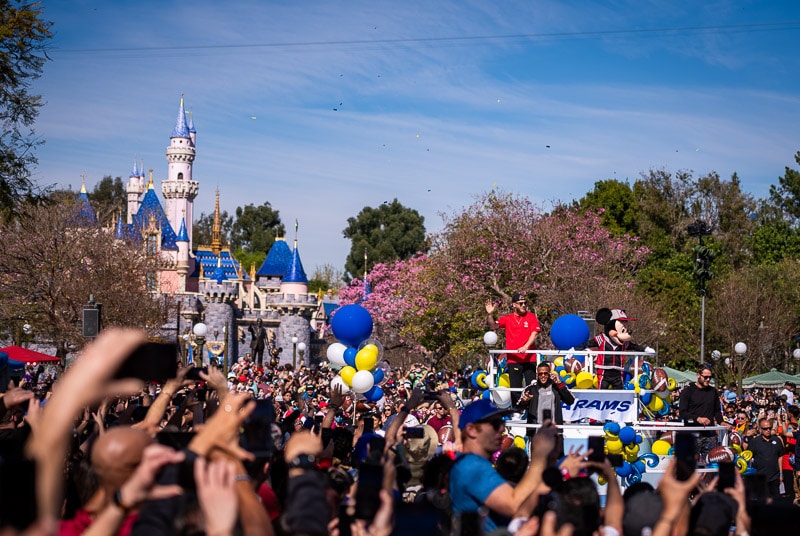
That won’t be an issue in 2026, 2027, and 2028 when the Super Bowl is hosted at Levi’s Stadium in Santa Clara, California this year followed by SoFi Stadium outside of Los Angeles, California in 2027. Both of the next two years, the parade will be at Disneyland.
In 2028, Mercedes-Benz Stadium in Atlanta, Georgia will host the Super Bowl, and the parade will return to Walt Disney World. That’s where it was held last year when MVP quarterback Jalen Hurts of the Philadelphia Eagles appeared.
Disneyland last hosted the Super Bowl parade from 2022 through 2024. In 2022, it featured hometown heroes Matthew Stafford, Cooper Kupp and Aaron Donald of the Los Angeles Rams. The following two years, it was Patrick Mahomes (again). He’s currently behind only Tom Brady for the most “I’m going to Disney” Super Bowl commercials; the two are for #1 in terms of actual parade appearances.

The “What’s Next” ad campaign has been extended beyond football. Disney has used it over the years during the NBA Finals, Olympics, World Series, and the Stanley Cup Finals. From 2008 to 2011, the winner of “American Idol” exclaimed that they’d be going to Disney as part of the marketing campaign.
Michael Jordan, Magic Johnson and Kareem Abdul-Jabbar are among the NBA stars who have announced they’re going to Disney after a championship win. Back in 2004, the Boston Red Sox did likewise, taking a trip to Walt Disney World after ending their team’s 86-year title drought.
The commercials are hit or miss in other sports, largely dependent on whether there’s a feel-good narrative or story to be told. We’ve heard that Disney wanted to do the commercial and celebratory parade for Shohei Ohtani at Tokyo Disneyland after he won his first World Series with the Los Angeles Dodgers, but the parties couldn’t come to terms.
Eisner is not sure why the commercial “hasn’t stuck” for other sports, saying that it might be a budgetary thing because it’s expensive and challenging. Presumably because all other major sports leagues have a lengthier series for crowning a champion, which also means there’s no single event everyone is watching.
In a quintessential Michael Eisner synergy move, Santa Claus uttered the famous phrase in a commercial at the end of the ABC Disney Christmas Day Parade for a few years in the late 1990s (watch below).
The “What’s Next” campaign has huge value as a marketing tool. It’s the same rationale for Disney’s similarly-successful ABC Christmas Day Parade. That’s less about the parade and more an hour-long commercial that organically puts Walt Disney World and Disneyland front of mind at a time when families are gathered together and discussing the year to come and summer vacation plans.
The same sentiment applies to the “What’s Next” Super Bowl commercial. The biggest differences are shorter duration, and that it features no footage promoting the parks. It’s nevertheless very valuable because the ad brings Disney to mind, is sentimental, aspirational, and All-American.
Other companies have also tried their own knock-offs of the commercial. Warner Bros. planned a similar campaign, which Eisner learned of: “I went completely nuts. I told Warner Bros., ‘That’s ours. You’d better stay away.’ I don’t know if we had a copyright, per se, but we had so ingratiated ourselves with America. We convinced Warner Bros. to back off. This was a Disney thing.”

Eisner said there was “never any doubt the campaign would keep going” and be a distinctly Disney thing because every year, a high school athlete will win something, and inevitably shout, “I’m going to Disney!” Eisner said many of them send that video to Disney, and he’s seen thousands of clips of kids proudly shouting those celebratory lines.
Eisner added: “In sports today, we focus on who is traded or cut or getting another contract. This is the other side of that. [The ad] has nothing to do with money or transactions, it’s just a moment of pure bliss and high achievement. It’s real.”
Does has gotten untold free advertising Disney out of the “What’s Next” campaign, too. As the saying has entered the pop culture zeitgeist, athletes and others who have achieved greatness have uttered “I’m going to Disneyland” in celebration without having any contract with the company.

According to oddsmakers, the players most likely to shout “I’m going to Disneyland” after Super Bowl LX are QBs Sam Darnold of the Seattle Seahawks or Drake Maye of the New England Patriots.
They’re followed by NFL Offensive Player of the year Jaxon Smith-Njigba (WR, Seahawks), as the top non-QB candidate after a 153-yard performance in the NFC Championship and Kenneth Walker III (RB, Seahawks). No defensive players are among the favorites, nor are any other offensive skill positions on the Patriots.
And of course, Detroit Lions Jared Goff, Jameson Williams, Sam LaPorta, Jack Campbell, Penei Sewell, Amon-Ra St. Brown, Aidan Hutchinson, Jahmyr Gibbs are all favorites for 2027 and 2028. Heck, maybe Jack Fox will appear in the parade both years, despite not having a single punt in either Super Bowl.

As for the 2026 parade at Disneyland, we’ll keep you posted about details once they’re announced tonight, so stay tuned! It usually occurs in the early afternoon, between around noon and 3 pm. With no daytime parade, Disneyland doesn’t have to contend with entertainment conflicts, so timing could be dictated by ESPN broadcast priorities.
First Take with Stephen A. Smith, multiple editions of SportsCenter, NFL Live and a second episode of Super Bowl Live will be broadcast live from Disneyland. ESPN will also welcome and honor a player from the Super Bowl LX championship team, so presumably the parade will occur during the ESPN daytime post-game coverage of Super Bowl LX.
If you’re visiting Disneyland on February 9, 2026, expect elevated crowds and congestion, especially if the local-ish Seattle Seahawks win. We expect restrictive reservation availability (you might want to grab those now–Annual Pass reservations are already fully booked, but day tickets have availability). Should be interesting to see–we’ll keep you posted!
Planning a Southern California vacation? For park admission deals, read Tips for Saving Money on Disneyland Tickets. Learn about on-site and off-site hotels in our Anaheim Hotel Reviews & Rankings. For where to eat, check out our Disneyland Restaurant Reviews. For unique ideas of things that’ll improve your trip, check out What to Pack for Disney. For comprehensive advice, consult our Disneyland Vacation Planning Guide. Finally, for guides beyond Disney, check out our Southern California Itineraries for day trips to Los Angeles, Laguna Beach, and many other SoCal cities!
YOUR THOUGHTS
Hoping for Sam Darnold, Drake Maye, or someone else to exclaim “I’m going to Disneyland” after the big game? Thoughts on the “What’s Next” Super Bowl commercial? Is it effective marketing and pop culture staple for Disney? Do you agree or disagree with our take? Any questions we can help you answer? Hearing your feedback–even when you disagree with us–is both interesting to us and helpful to other readers, so please share your thoughts below in the comments!